
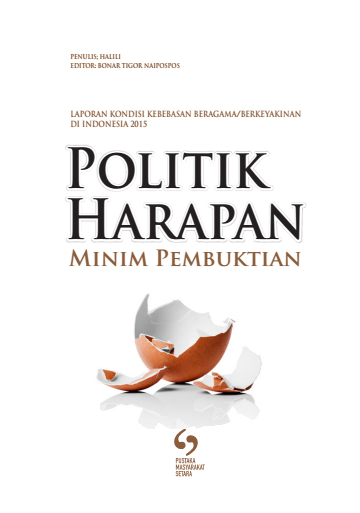
Politics of Hope: Little Evidence (Indonesian)
Summary
As the ninth report and the first report issued during President Joko Widodo’s term—which is only 15 months into his leadership—this report has its own distinct characteristics compared to previous reports. In addition to documenting events that occurred throughout 2015, this report challenges the SETARA Institute to trace, analyze, and draw conclusions regarding the political promises made during the 2014 presidential and vice-presidential election campaigns. Through this review process, “POLITICS OF HOPE: LACK OF PROOF” was chosen as the title of this report.
An analysis of the lack of fulfillment of Jokowi’s political promises is presented in Chapter IV, which evaluates the “Nawa Cita” and Jokowi’s leadership. The title mentioned above is the most representative phrase to describe Jokowi’s leadership performance, which, over more than a year in office, has yet to demonstrate a commitment to advancing and protecting freedom of religion and belief.
Jokowi has taken no action despite having the authority to do so. The year 2015 marked the very beginning of President Joko Widodo’s leadership. Therefore, 2015 is an opportune time to evaluate the policies that have and have not been implemented from the start of his leadership through the end of 2015. This evaluation covers prominent trends during his tenure as head of state and head of government. These trends span various areas of governance where Jokowi has contributed to the accumulation of issues involving violations of freedom of religion and belief.
It should be noted that the issues raised in this section constitute an evaluation of the promises and new hopes outlined in the Nawa Cita. This evaluation is based on data from a checklist, analysis of policy documents, and in-depth interviews with stakeholders on issues of religion and belief—primarily the Ministry of Religious Affairs, the Ministry of Home Affairs, and local governments. At the local government level, Nawa Cita has had virtually no impact on improving local policies that guarantee freedom of religion and belief. Data from 2015 indicates that local governments (in this case, regencies and cities) were recorded as perpetrators of violations of freedom of religion or belief within the category of state institutions. We extend our gratitude to all parties who supported the publication of this book.