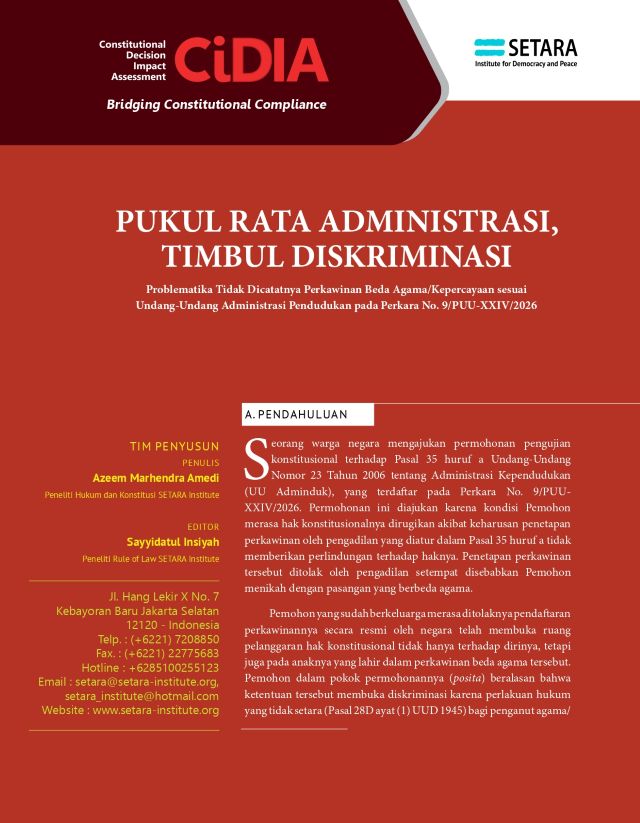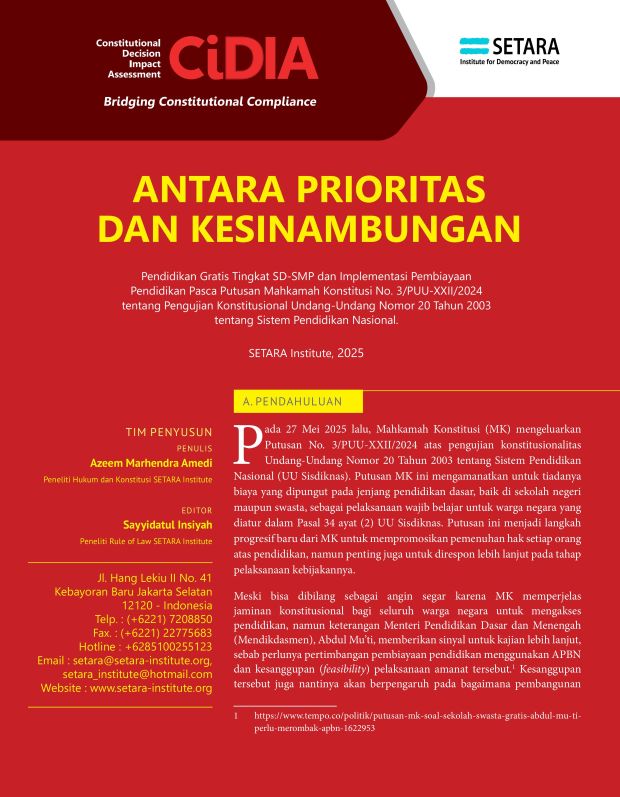

An Analysis of the Impact of the Constitutional Court’s Ruling
Constitutional Court rulings are binding in the same way as laws, meaning that their impact can have far-reaching consequences for the governance of the state and democratic life.
Legal instruments must not be used as tools of oppression. We are here to oversee the judiciary and overturn regulations that infringe upon citizens’ fundamental rights.
Everyone has the right to security, protection and fair treatment, and to equality before the law.
Ensuring that those in power adhere to the mandate of the 1945 Constitution in order to prevent abuse of power and protect citizens’ rights.
Ensuring that the structure, substance and culture of the law are geared towards achieving justice, certainty and public benefit.
The Constitution stipulates that sovereignty resides with the people. It is important to prioritise citizens as the focal point of legal policy-making.
SETARA’s research on law and the constitution has contributed to the restoration of citizens’ constitutional rights by urging state actors to fulfill their responsibilities
The research and policy advocacy conducted by SETARA have contributed to raising public awareness of the importance of upholding the pillars of constitutional democracy, such as respect for the constitutional rights of fellow citizens.
The town hall meetings organized by SETARA in various regions have served as a bridge between the aspirations of the public—particularly marginalized groups—and various stakeholders, facilitating the formulation of a more accountable and inclusive regional development agenda.
SETARA’s interventions have helped to promote greater participation, particularly among vulnerable groups, in the formulation of Regional Medium-Term Development Plans (RPJMDs) and policies, especially at the local level.
The research and advocacy conducted by SETARA have contributed to the adoption of various more inclusive policies.
SETARA’s monitoring of policies—particularly discriminatory ones—has also contributed to efforts to review various regulations that are inconsistent with the Constitution, higher-ranking laws, and human rights values.
SETARA’s interventions have helped promote more participatory policy-making, particularly by involving vulnerable groups in the legislative process.
SETARA’s presence through its regional programs not only creates more opportunities for dialogue but also strengthens existing CSO networks at the local level to advocate for constitutional rights, particularly those of marginalized groups.
The formation of cross–issue coalitions in several regions has provided new momentum for marginalized groups (religious and belief minorities, people with disabilities, women, indigenous peoples, and gender and sexual minorities). Meetings and collaboration among these marginalized groups have increasingly fostered a sense of safety and comfort, enabling them to work together to advocate for their constitutional rights, which have often been restricted or violated.
To provide the general public with an understanding of the fundamentals of law, their legal rights and obligations, and the constitutional rights inherent to every individual.
SETARA’s interventions on inclusive governance in a number of cities and regencies have led to the integration of inclusive governance principles into various local development agendas.
SETARA’s strategic engagement with various local governments has led to the launch of a variety of programs that promote the advancement of human rights.
The collaboration promoted by Setara between civil society coalitions and the government—particularly at the local level—has fostered more accountable oversight mechanisms for local government performance.
Discover SETARA Institute’s areas of focus in strengthening democracy, human rights, and social justice across various sectors.