

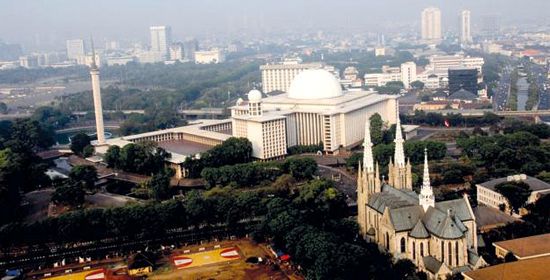
The case of violence that occurred in Aceh Singkil provides a valuable lesson in the governance of Indonesia’s diversity. The fundamental cause of this case and hundreds of other cases is due to the maintenance of various discriminatory statutory and regulatory products related to the establishment of places of worship. As long as this discrimination is inherent in legal products, the potential for incidents of attacks on places of worship will continue to occur.
The government under Joko Widodo must as soon as possible revise the Joint Ministerial Regulation (PBM) No. 9 and 8 of 2006 concerning Guidelines for the Implementation of Duties of Regional Heads/Deputy Regional Heads in Maintaining Religious Harmony, Empowering the Forum for Religious Harmony, and the Establishment of Houses of Worship, without waiting for the legislative process in the House of Representatives (DPR) and the government which plans to draft a Law on the Protection of Religious Communities. The PBM, which contains 9 locus of discrimination, must be changed, specifically the clause stating that the establishment of houses of worship must obtain the approval and signature support of local residents. Because this is an initial form of limitation and restriction.
The establishment of houses of worship is part of the freedom of expression and assembly (freedom of expression and assembly). It is the right of every citizen guaranteed by the 1945 Constitution of the Republic of Indonesia and international conventions. It becomes problematic when this right of every person must first obtain the approval of others. The government should facilitate the granting of permits for the establishment of houses of worship if it has quantitatively become a real need of a number of citizens. The issue of houses of worship is the entry point of the tangled thread of intolerance issues that have developed over the last ten years. An issue used as an entry point by several parties to muddy the situation with a number of their interests.
President Joko Widodo is expected to issue a Presidential Regulation concerning the Establishment of Houses of Worship which facilitates the granting of permits and instructs regional governments to facilitate the practical and urgent needs of citizens for houses of worship. To obtain serious handling, the government is also encouraged to form a Religious Freedom Commission consisting of community leaders committed to diversity and human rights, rather than merely representing interfaith groups. One of the tasks of this Commission is to identify problems faced by citizens in each region concerning the implementation of religious freedom. This Commission will compile periodic reports and provide recommendations and proposals to the government regarding steps to advance religious freedom.
In general, the government must also review and cancel a number of regional regulations as well as written agreements or claims of verbal agreements that contradict the constitution and ratified international conventions. Such as the agreements and consensus made under pressure in Singkil in 1979 and Governor Regulation 25/2007 concerning Guidelines for the Establishment of Houses of Worship.
Contact Person: Bonar Tigor Naipospos, Deputy Chair of Setara Institute: 0811819174