

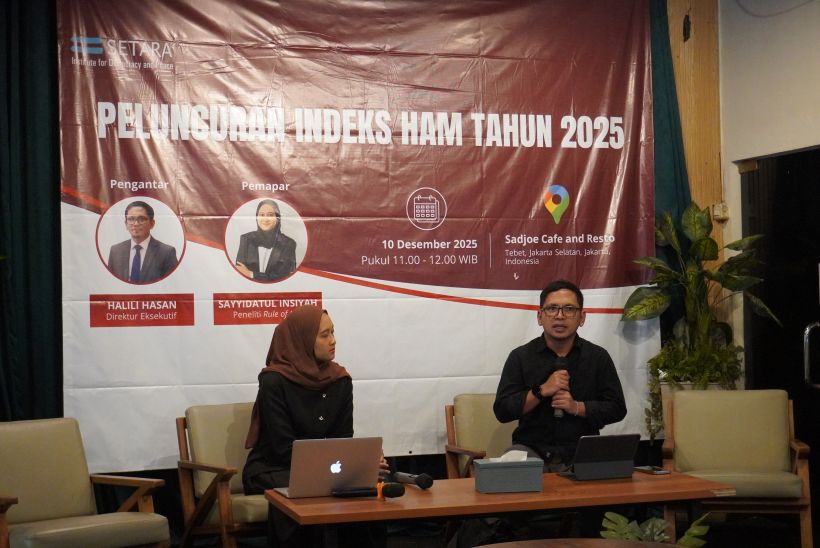
To mark International Human Rights Day 2025, the SETARA Institute has compiled the 2025 Human Rights Index to provide an overview of the human rights situation throughout 2025. This index was compiled by evaluating 50 sub-indicators classified into 6 indicators of civil and political rights and 5 indicators of economic, social, and cultural rights. Ratings were assigned on a scale of 1 to 7, where 1 represents the worst progress in human rights and 7 represents the best progress in human rights.
The average score for all variables in the 2025 Human Rights Index is 3.0, a decrease of 0.1 points from the 2024 Human Rights Index, which recorded a national average score of 3.1. The low national average score in the 2025 Human Rights Index reflects that the implementation of the commitment to strengthen human rights, as outlined in Asta Cita 1 of the Prabowo-Gibran administration, has not yet been tested during its first year in office.
The overall score of the 2025 Human Rights Index is driven by the economic, social, and cultural rights (ESCR) variable, which recorded a higher score than civil and political rights (CPR)—3.2 for ESCR and only 2.8 for CPR. This situation indicates that there is a serious cause for concern regarding the enjoyment of rights (rights enjoyment) in the civil and political spheres under President Prabowo’s administration. As for the economic, social, and cultural rights variable, the higher score in this area indicates that President Prabowo’s leadership on the global stage demands that ministers, as policy implementers, act swiftly to strengthen measures for advancing national human rights—particularly in fulfilling economic, social, and cultural rights—especially given the complex challenges at the implementation level that have resulted in suboptimal progress toward fulfilling these rights.
The score for the indicator of freedom of expression and opinion continues to remain the lowest-scoring indicator each year. A score of just 1.0 on this indicator points to the poor quality of freedom of expression as well as massive efforts to curtail civic spaces. Repression of mass protests during waves of demonstrations, terror and intimidation against journalists, criminalization under the ITE Law, and interference with academic freedom are all manifestations of restrictions on critical expression.
The indicator for the right to justice, which scored 3.1, reflects a situation in which the administration of justice is increasingly deteriorating. The whitewashing of past wrongs through plans to rewrite history by ignoring the facts of the 1998 human rights violations, the perpetuation of impunity through the designation of President Suharto as a national hero, and the repression of numerous human rights defenders are all evidence of a lack of commitment to upholding the right to justice. The absence of the Ministry of Human Rights in various cases of human rights violations further reinforces the view that the Ministry of Human Rights is merely an institutionalization of human rights carried out by President Prabowo to distract the public and create the perception that the President has a strong commitment to advancing human rights, without ensuring that this institution truly functions optimally as the spearhead in carrying out the state’s responsibility to guarantee respect for and fulfillment of human rights.
The country has taken several progressive steps to strengthen citizens’ right to participate in government, even though the score on this indicator is only 3.0. Progress in ensuring opportunities for inclusive public participation through democratic elections was enshrined in Constitutional Court Decision No. 62/PUU-XXII/2024, which was issued in January 2025. This ruling offers new hope for breaking the parties’ hegemony over the presidential threshold, which has long been dominated by major parties and rife with transactional politics. Constitutional Court Decision No. 169/PUU-XXII/2024 dated October 30, 2025, also provides new momentum to ensure that women can fully participate and enjoy equal rights in holding leadership roles at all levels of decision-making within the House of Representatives’ supporting bodies.
Within the economic, social, and cultural rights variable, the indicator for the right to education contributed the highest score to this variable’s achievement, at 4.3. Constitutional Court Decision No. 3/PUU-XXII/2024, which reaffirms the exemption from tuition fees for elementary school and junior high schools as a step toward increasing participation in basic education and expanding accessibility and accommodation for inclusive education. The policy to increase teacher allowances through Presidential Regulation No. 79 of 2025 and Minister of Religious Affairs Regulation No. 4 of 2025 reflects the government’s good faith as part of its efforts to improve the quality of national education by empowering teachers as the spearhead of the learning process. In terms of tertiary education, the Indonesia Smart Card Scholarship for College (KIP-K) program is also part of the government’s efforts to increase participation in higher education, which remains a major challenge in Indonesia’s human resource development.
A score of 3.6 on the right to health indicator reflects the continued need for comprehensive improvements in fulfilling the right to health. The guarantee of a safe and clean environment—as a means of fulfilling the right to health through a decent environment—is increasingly being neglected. As the country ranked second in the world for the highest rate of deforestation, Indonesia has lost 22.28% of its forest area due to deforestation. The flash floods in Aceh and Sumatra illustrate that compliance with responsible business practices has not yet been fully implemented.
The score of 3.4 for the right to work in the 2025 Human Rights Index indicates that, although the country has consolidated its efforts as a collective measure to fulfill economic rights, the reality on the ground shows that the country still has a great deal of work to do in ensuring well-being through the fulfillment of the right to work. 1.27 million child laborers, 462,241 workplace accidents, human trafficking, and violence against informal workers pose major challenges for the country in ensuring not only the fulfillment of the right to work but also the holistic protection of workers’ rights.
The land rights indicator remains the country’s worst performance in fulfilling economic, social, and cultural rights, with the government scoring only 1.6 this year. Instead of correcting the policies of the previous administration, President Prabowo has continued the development of Strategic National Projects (PSN), which perpetuate agrarian conflicts and the seizure of customary lands. The militaristic approach promoted by the state has shown that the government is not addressing land issues appropriately and is, in fact, fueling protracted conflicts. The Special Committee on Agrarian Conflict Resolution, formed by the Indonesian House of Representatives in October 2025, must take serious steps to accelerate the resolution of agrarian disputes and the implementation of agrarian reform.
In light of the findings in the Human Rights Index, the SETARA Institute urges President Prabowo to strengthen policies promoting human rights by enacting a number of progressive bills aimed at advancing human rights and by reviewing policies and programs that are counterproductive to human rights to ensure that human rights violations do not recur. []
Contact:
Sayyidatul Insiyah, Research Manager at the SETARA Institute
Halili Hasan, Executive Director of the SETARA Institute