
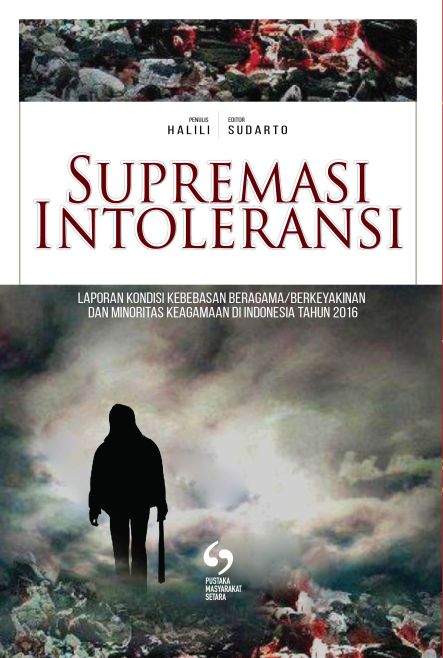
The Supremacy of Intolerance (Indonesian)
Summary
The year 2016 marked the 10th year that the SETARA Institute has conducted research and monitoring on the state of freedom of religion and belief (KBB) in Indonesia. Starting this year and moving forward, the SETARA Institute will pay special attention to religious minorities in addition to the broader state of KBB. This decision is driven by at least the following factors.
First, conceptually, democracy is a system of governance based on majority rule that guarantees the protection of minority rights. Human rights, including minority rights, are an intrinsic part of democracy.1 Thus, as a democratic nation, Indonesia must make minority rights an inseparable part of its political, legal, and social systems.
Second, philosophically, the ideal of an independent Indonesia is “all for one (Indonesia), one for all.” Pancasila and the national motto, Bhinneka Tunggal Ika, have explicitly envisioned a political system open to all elements that constitute the nation-state, whether large or small, many or few. The articles of the national constitution, the 1945 Constitution, whether in their form as a “rechtsidee” or as a “staat fundamentalnorm,” reaffirm the foundational framework of a “state of all for all,” as idealized by the founders of the nation-state and intrinsically outlined in the nation’s founding principles and motto. Thus, politico-legal regulations at the governance level must be built upon this philosophical-constitutional foundation.
Third, at the level of derivative law, Article 27 of the International Covenant on Civil and Political Rights (ICCPR)—which has been ratified as Law No. 12 of 2005—specifically guarantees the rights of minorities. Consequently, the agenda of enforcing these rights should be a concern for all parties so that the law does not merely serve as a protector of the majority group but also as a protector for those who are anthropologically considered minorities.
Fourth, statistically speaking, based on research and monitoring data from the SETARA Institute from 2007 to 2016—the report of which is in the reader’s hands—minorities have been the primary victims of acts and incidents of human rights violations to date.
The protection of the rights of religious minorities cannot, of course, be separated from the issue of freedom of religion and belief. Attention to the fulfillment of the rights of religious minorities goes hand in hand with the fulfillment of the fundamental right to freedom of religion and belief. Relationally, the right to freedom of religion and belief intersects with the right to freedom of religion and belief, which is adequately guaranteed as an individual right in various international human rights instruments.
Substantively, the right to freedom of religion and belief is viewed as an individual right that cannot be curtailed and whose fulfillment cannot be deferred (non-derogable rights). Therefore, the state must guarantee the fulfillment of freedom of religion or belief for both individuals and groups.2 The principle of non-derogable rights affirms that these rights are absolute and, as such, cannot be suspended or deferred under any circumstances.
In line with this, Indonesia’s constitutional structure provides more than adequate guarantees for the implementation of freedom of religion or belief. These guarantees can be found in the fundamental norms (grundnorm) of national legislation and in the country’s fundamental law (staat fundamentalnorm).
Pancasila, as the foundation of the state, has provided a philosophical and moral guarantee of freedom of religion and belief. The first principle of Pancasila affirms this. Although in reality, this “principle of all principles” is often interpreted paradoxically. On the one hand, the first principle is understood as a principle that accommodates meta-religious spirituality; on the other hand, it is often interpreted as a formulation referring to a formalistic conception of religiosity—even, for the sake of legitimizing the dominance of the predominant religious community. On the other hand, the first principle is interpreted as a philosophical foundation for religiosity that draws on the concept of tauhid, meaning it is reduced merely to serving as an umbrella for the quantitative majority of a specific religion in Indonesia—in this case, Islam.
The most authentic and profound reference for reading and interpreting the first principle of Pancasila is the statement delivered directly by the founding fathers and mothers of the nation and state during the sessions of the Preparatory Committee for Indonesian Independence (BPUPKI), particularly at the meeting regarding the formulation of the state’s foundational principles. One of them—indeed, the most pivotal figure due to his historical role as the architect of Pancasila—was Sukarno. The Son of the Dawn, while discussing the principles of Pancasila on June 1, 1945, through his impassioned speech, provided a clear and unequivocal affirmation regarding the principle of belief in God.
As a fundamental norm, legal ideal (rechtsidee), philosophical foundation (philosofische gronslag), worldview (weltanschauung), national ideology, foundation of the state, and the source of all sources of law in Indonesia, Pancasila should be enshrined in constitutional guarantees that are more operational, concrete, and binding. We can find these guarantees in our constitution, the 1945 Constitution of the Republic of Indonesia (UUD 1945).
The 1945 Constitution contains several provisions that guarantee citizens’ rights to practice religion and hold beliefs. At least two articles in the 1945 Constitution can be identified as directly guaranteeing freedom of religion for everyone, whether citizens or non-citizens.
This monitoring research and the publication of this annual report aim to: [1] document and publish facts regarding violations and breakthroughs/progress in the guarantee of freedom of religion and belief in Indonesia; [2] urge the state to fully guarantee freedom of religion or belief, including by amending various laws and regulations that restrict such freedoms and by restoring the rights of victims; [3] provide baseline data on freedom of religion or belief; and [4] strengthen civil society networks and the general public to expand the constituency so that they can participate in promoting the guarantee of freedom of religion or belief.