

Jakarta, 21 August 2024
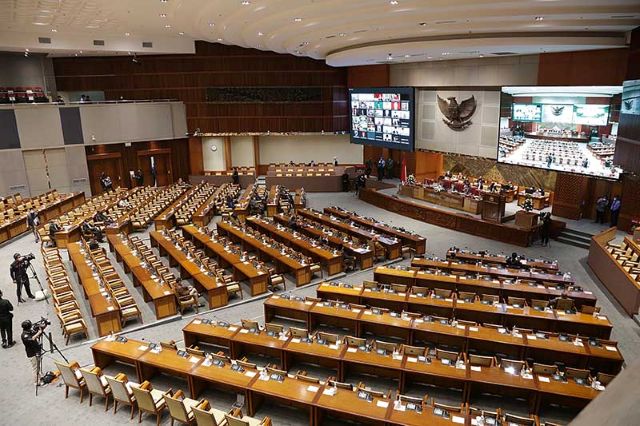
The House of Representatives (DPR RI) Legislative Body’s approval of the revision to the Regional Elections Law (UU Pilkada), which it claims is a follow-up to the Constitutional Court’s ruling on the nomination requirements for candidates for governor, regent, and mayor, represents a form of vetocracy by segments of the political elite who are determined to dominate every political arena in the 2024 simultaneous regional elections. In the context of this revision, vetocracy takes the form of an elite agreement that vetoes public aspirations and the constitutional interpretive authority previously exercised by the Constitutional Court through Decision No. 60/PUU-XXII/2024, which sought to safeguard democracy from the hegemony and tyranny of the majority.
Not only does it defy the Constitutional Court’s ruling, but the seven-hour revision to the Regional Elections Law is also substantively and procedurally flawed. The formulation of candidate eligibility requirements has been interpreted according to the preferences of these vetocrats in order to secure control over every channel of candidacy in the regional elections. The varied nomination thresholds established by the Constitutional Court were interpreted by the DPR as inapplicable to political parties that already hold seats in regional legislative councils (DPRD). Similarly, the constitutional interpretation regarding the minimum age of 30 years for gubernatorial and vice-gubernatorial candidates has been manipulated by calculating the age requirement from the time of candidacy.
The Constitutional Court’s ruling should apply exactly as issued once it has obtained final and binding legal force and is self-executing. The legal standing of a Constitutional Court decision is equivalent to that of a law. The DPR’s failure to comply with the ruling therefore constitutes a violation of the law, undermining not only the constitutional order but also the principle of checks and balances.
The increasingly fragile state of Indonesia’s democracy, reflected in the rushed revision of the Regional Elections Law for elite interests and the defiance of the Constitutional Court’s decision, demonstrates the absence of constitutional leadership in constitutional interpretation, despite Indonesia having a Constitutional Court. No institution other than the Constitutional Court has the authority to definitively interpret the Constitution, as it holds judicial supremacy in upholding constitutional supremacy.
The Constitution and the Constitutional Court no longer hold judicial supremacy in constitutional interpretation because, in the end, the will of the vetocrats has prevailed over the public interest. Without constitutional leadership, Indonesia’s constitutional system will become increasingly fragile and drift further away from the republican mandate, as the people and their aspirations are no longer the central consideration in legislative drafting and public policymaking.
Media Contacts:
Azeem Marhendra Amedi, Researcher on Law and Constitutional Affairs, SETARA Institute
Ismail Hasani, Chair of the Board of SETARA Institute; Lecturer in Constitutional Law, UIN Syarif Hidayatullah Jakarta: +62 8111 2007 248