

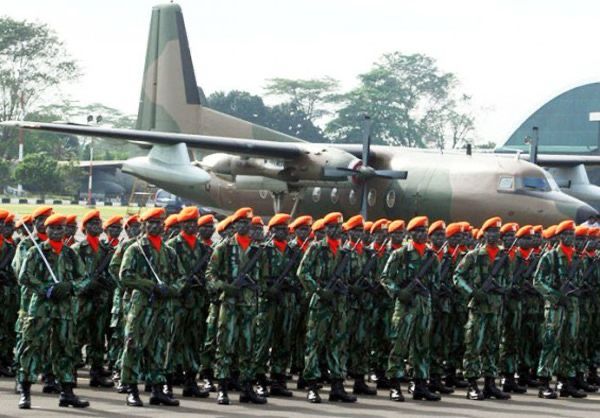
Following the announcement by the Minister of Defense in November 2024, the proposal to establish Development Battalions has continued to attract public scrutiny because it assigns non-defense functions to these battalions, including livestock farming, fisheries, agriculture, and healthcare. This proposal clearly distorts the defense function constitutionally mandated to the Indonesian National Armed Forces (TNI) under the pretext of maintaining security stability and promoting public welfare.
Despite widespread public criticism, by June 2025, the proposal had moved closer to implementation through the large-scale recruitment of 24,000 enlisted soldiers (Tamtama) to establish Territorial Development Battalions, which would be deployed across Indonesia to support stability and development in 514 regencies and municipalities. As stated by the Minister of Defense, the Head of the Indonesian Army Information Service (Kadispen TNI AD) also emphasized that this large-scale recruitment was intended not for combat operations, but to address community needs, ranging from food security to healthcare services.
In response to these developments, SETARA Institute offers the following observations:
- The establishment of the Territorial Development Battalions represents a new form of old-style militarism, characterized by the expansion of military involvement into the civilian sphere under the guise of development and public welfare. Militarism thus re-emerges as an instrument of political power and regime support, reminiscent of the practices of the New Order era.
- The rhetoric of development cannot conceal the reality that the military is expanding its role and influence into areas beyond its constitutional authority. The creation of non-combat battalions constitutes a deviation from the mandate of the 1998 Reform Movement, which explicitly separated the military from civilian affairs. It also represents a clear sign of the reversal of TNI reform through non-compliance with the limitations governing Military Operations Other Than War (OMSP) as stipulated in the newly amended TNI Law, both in terms of their scope and legal basis.
- The establishment of these Development Battalions results in a distortion of the military’s defense function. At a time when countries around the world are strengthening their military capabilities through technological advancement, improving troop capacity and professionalism, modernizing defense equipment, and enhancing soldiers’ welfare to address evolving security threats, the TNI is instead diverting its focus by recruiting thousands of enlisted personnel to perform civilian functions that are already the responsibility of existing civilian authorities. Even if the establishment of new military units were deemed necessary, with a proportionate number of personnel, they should instead be directed toward strengthening national defense logistics, which currently remain stagnant, including strategic resource management to ensure adequate ammunition supplies, food logistics, and distribution systems, rather than performing civilian functions that properly belong to non-military institutions.
- The recruitment of tens of thousands of additional personnel is also likely to increase the government’s fiscal burden, particularly in relation to salaries, infrastructure, and personnel development. Given the urgent need to strengthen defense equipment and improve soldiers’ welfare, budgetary priorities should instead be directed toward these essential areas.
- This recruitment further demonstrates a defense orientation that neglects Indonesia’s maritime and air domains. Rather than strengthening the Navy and Air Force, whose roles are becoming increasingly critical amid the region’s evolving geopolitical landscape—including rising tensions in the North Natuna Sea, disputes in the South China Sea, and the increasing number of airspace violations in Indonesia’s eastern region—this policy instead widens the imbalance in personnel distribution among the armed services, with the Indonesian Army (TNI AD) already significantly outnumbering the Navy (TNI AL) and the Air Force (TNI AU).
- The Government and the House of Representatives (DPR) should immediately evaluate this mass recruitment and halt the establishment of non-combat battalions that violate the boundaries of the military’s role in a democratic state and represent a regression in the reform of the Indonesian National Armed Forces.
Media Contacts:
- Ikhsan Yosarie, Researcher on Human Rights and the Security Sector, SETARA Institute
- Merisa Dwi Juanita, Researcher on Human Rights and the Security Sector, SETARA Institute