

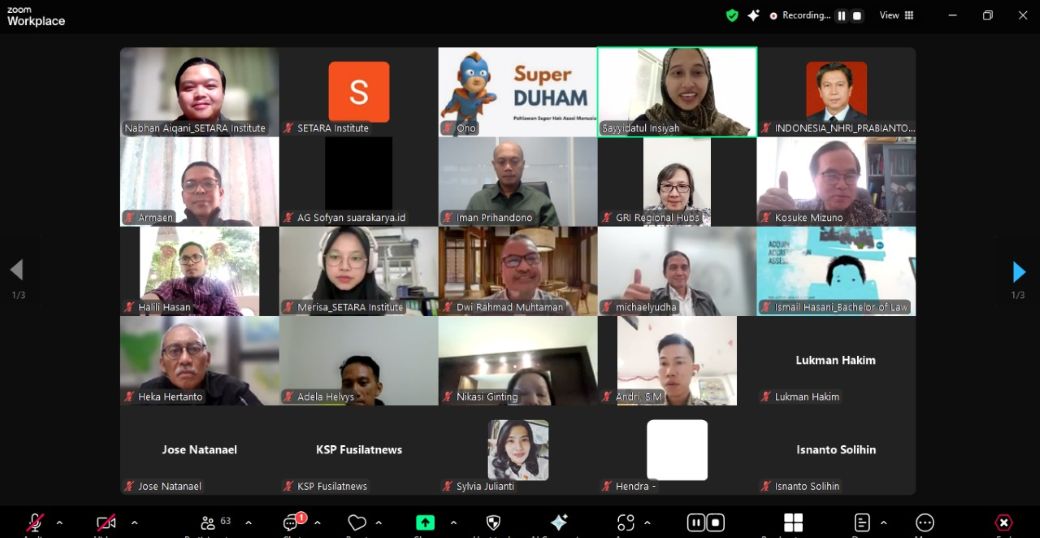
SETARA Institute, in collaboration with the Sustainable-Inclusive Governance Initiative (SIGI), launched a report entitled “Business and Human Rights (BHR) Outlook 2025: 10 Priority Issues on Business and Human Rights in Indonesia” on Tuesday, 25 February 2025. The report presents an outlook and forecast on the global and national situation, as well as the challenges surrounding Business and Human Rights (BHR). The BHR Outlook aims to encourage all stakeholders to pay greater attention to, and jointly develop, strategies that promote the integration of human rights principles into business operations.
The priority issues were identified based on the Environmental, Social, and Governance (ESG) risk framework in corporate governance. The report identifies the following 10 priority Business and Human Rights issues that are closely linked to ESG-related risks:
- Ensuring transparent and accountable governance in the plantation, mining, and infrastructure development sectors;
- Promoting equitable carbon trading schemes, climate change mitigation, and deforestation prevention;
- Ensuring the protection of rights for gig workers, informal sector workers, and domestic workers;
- Strengthening the protection of workers and trade unions to achieve decent work;
- Ensuring the protection of migrant workers, both on land and at sea, from human rights violations that adversely affect them;
- Ensuring a just transition within the context of the just energy transition;
- Ensuring policy harmonization to strengthen human rights protection in business operations;
- Promoting mandatory Human Rights Due Diligence (HRDD) policies;
- Preventing the financial sector from financing projects that pose risks of human rights violations; and
- Responding seriously to efforts to integrate Business and Human Rights into ESG frameworks.
Iman Prihandono, Dean of the Faculty of Law at Airlangga University (Unair) and an academic specializing in Business and Human Rights, welcomed the initiative as an important step toward establishing a more mature Business and Human Rights ecosystem. He emphasized that this research initiative should become an annual agenda to strengthen practical discourse on Business and Human Rights in the future. He also suggested that Business and Human Rights should be recognized as a distinct academic discipline and incorporated into university curricula.
Kristy Nelwan, Head of Communication at Unilever Indonesia, stated that human rights, inclusion, and diversity have become core principles within the company’s business operations. She noted that the BHR Outlook could serve as a practical guide for companies in identifying and addressing key areas requiring attention as part of their commitment to responsible business practices.
Also speaking at the report launch, Lany Harijanti, Regional Implementation Manager of the Global Reporting Initiative (GRI) ASEAN, emphasized the importance of raising awareness among companies and adapting the terminology surrounding human rights, which is often not readily accepted by the corporate sector. She stressed that an appropriate approach is needed to integrate Business and Human Rights into companies’ day-to-day operations. She also highlighted the need to update the Indonesian Sustainable Finance Taxonomy (TKBI) and Financial Services Authority Regulation (POJK) No. 51/2017, while advocating for Human Rights Due Diligence (HRDD) as an essential disclosure requirement for companies. Furthermore, she underscored the importance of stricter oversight of companies operating at the lower tiers of supply chains, where forced labor and child labor practices frequently occur.
Representing the International Organization for Migration (IOM) Indonesia, Michael Yudha Wiratno emphasized that the protection of migrant workers cannot be separated from the three pillars of the United Nations Guiding Principles on Business and Human Rights (UNGPs). Given the vulnerability of migrant workers to human rights abuses, he stressed the need for stronger state protection through comprehensive policies and regulations. Building on this discussion, Armaen bin Abdullah, a humanitarian worker with IOM Ukraine, highlighted the importance of ensuring protection for Indonesian migrant workers (PMI) located in conflict-affected areas.
Prabianto Mukti Wibowo, Commissioner of the National Human Rights Commission (Komnas HAM), emphasized the urgency of introducing mandatory Human Rights Due Diligence (HRDD) regulations through a phased implementation, particularly in high-risk sectors. Regarding the financial sector, he encouraged SETARA Institute to continue its research and advocacy efforts amid the rapid expansion of ESG-based investment.
SETARA Institute believes that the ESG framework provides an effective foundation for integrating Business and Human Rights principles. Issues such as governance in the plantation, mining, and infrastructure sectors are closely aligned with the environmental and governance dimensions of ESG. Likewise, ensuring the protection of workers and trade unions to achieve decent work corresponds directly to the social pillar of ESG. Similarly, promoting equitable carbon trading schemes, climate change mitigation, and deforestation prevention aligns with ESG’s environmental objectives. Beyond that, the growing momentum of ESG-based investment and financing within the financial sector should be harmonized with Business and Human Rights principles to ensure that the United Nations Guiding Principles on Business and Human Rights (UNGPs) are implemented fairly and responsibly—from principles to practice.
Media Contact:
Nabhan Aiqani, Researcher on Business and Human Rights, SETARA Institute, +62 813-6772-1163