

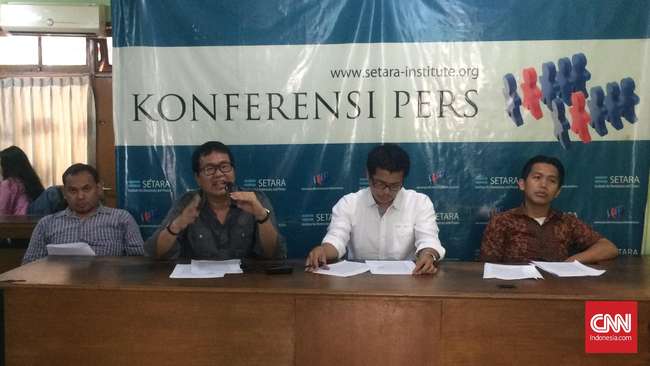
SETARA Institute and the Indonesian Paralegal Network (JPI) conducted qualitative research in Pringsewu Regency (Lampung), Tasikmalaya Regency (West Java), Banyumas Regency (Central Java), and Kulonprogo Regency (DIY) to identify a number of challenges in implementing the Village Law, including ensuring the availability of social accountability tools for village development. This research, held from August to October 2015, was conducted by interviewing key informants from various elements using a participatory action research approach.
The implementation of Law No. 6/2014 concerning Villages has become the foundation for village development since the Jokowi-JK Working Cabinet was inaugurated. However, since they were first inaugurated, the Ministry of Villages, Disadvantaged Regions and Transmigration (Kemendes PDTT) and the Ministry of Home Affairs (Kemendagri) are still preoccupied with drafting institutional structures and operational regulatory tools for village development. Up to one year of working, the government’s main focus is still limited to how to ensure that the 20.76 trillion village fund is disbursed. The government tends to neglect to:
- design village development and village potential whose actual asset value exceeds 20.76 trillion. As a result, village affairs are only about those funds even though, besides the very large value of village development, democracy and village governance, as well as strengthening the village consultative body (BPD) are also keys to the success of village development;
- provide tools to ensure that village funds are used appropriately. The government is limited to providing regulations, but has not seriously improved anti-corruption capacity, planning capacity, capacity to govern public aspirations and participation, and the capacity to draft village regulations that are conducive to village development; and
- provide tools to ensure how accountability principles work and guard village development. As a result, 1 year in, the implementation of the Village Law is carried out without adequate accountability. Social accountability focuses on efforts to strengthen participatory-inclusive village governance, the availability of space for the community and critical groups, ensuring that rights and justice issues become the mainstream basis for implementing development, including the availability of access for the community to obtain those rights and justice.
The government’s promise to provide facilitators in every village was also not fulfilled on time. As of October 2015, the Ministry of Villages, PDTT admitted that it had just launched Village Local Facilitators (PLD) in several areas which would work effectively in November-December 2015. In the study area, no village facilitators were found to have started working. The protracted provision of village facilitators has contributed to the passive dynamics of implementing the Village Law in the first year of the Working Cabinet.
The alleged politicization of the procurement of facilitators further distances public hope for the availability of quality facilitators. This politicization issue must be clarified not by individuals but by other credible parties. The State Civil Apparatus (ASN) Commission must conduct an audit of this recruitment process, because if left unchecked, tens of thousands of facilitators will not serve for village development but rather serve the political interests of the party.
At the institutional level of village development organizers, institutional dualism, namely Kemendagri and the Ministry of Villages PDTT (+ the central role of the Ministry of Finance) will continue to be an obstacle to accelerating village development. A division of authority among ministries that do not hold each other hostage is needed to realize a cohesive synergy in building villages.
Village governments are still experiencing uncertainty in carrying out their roles following the enactment of the Village Law in 2015. Village governments need an improvement in the quality of human resources and systematic assistance so they can carry out their roles more optimally.
Participatory and inclusive village development will not be achieved if the idea of social accountability is not adopted in various government policies. The government needs to adopt this idea by expanding the involvement of civil society organizations in village development. Realizing the social accountability of village development cannot solely rely on village governments and village facilitators. But it requires the participation of the community and critical groups working systematically. Village officials potentially reject the idea of strengthening social accountability because they will become the subjects of supervision. Meanwhile, village facilitators will work closely with village governments, making it difficult to expect their independence. Especially since they are suspected to have been politicized for political interests. The BPD cannot be expected either, because strengthening in this sector has not been carried out at all.
The most feasible entity to guard the realization of social accountability in village development is by utilizing paralegals, legal cadres, or other designations. The independence of paralegals, who generally gather in legal aid organizations and people’s organizations, is needed in the context of advocating for basic service rights in the village, encouraging public participation, acting as agents of democratic participation, becoming discussion partners in drafting village regulations, and being actors who provide village-based legal services. Paralegals are also needed as a different set of eyes as monitors of village fund accountability. All roles identified and stated as needs are instruments for realizing the social accountability of village development.
[Summary of Village Development Social Accountability Research Report.pdf]
Contact Person:
- Ismail Hasani, Director of Research at SETARA Institute & Lecturer in Constitutional Law at UIN Syarif Hidayatullah Jakarta: 08111 88 4787.
- Abdul Hamim Jauzie, National Coordinator of the Indonesian Paralegal Network (JPI): 08568333960.