
CiDIA: Interfaith Marriage 2026
Summary
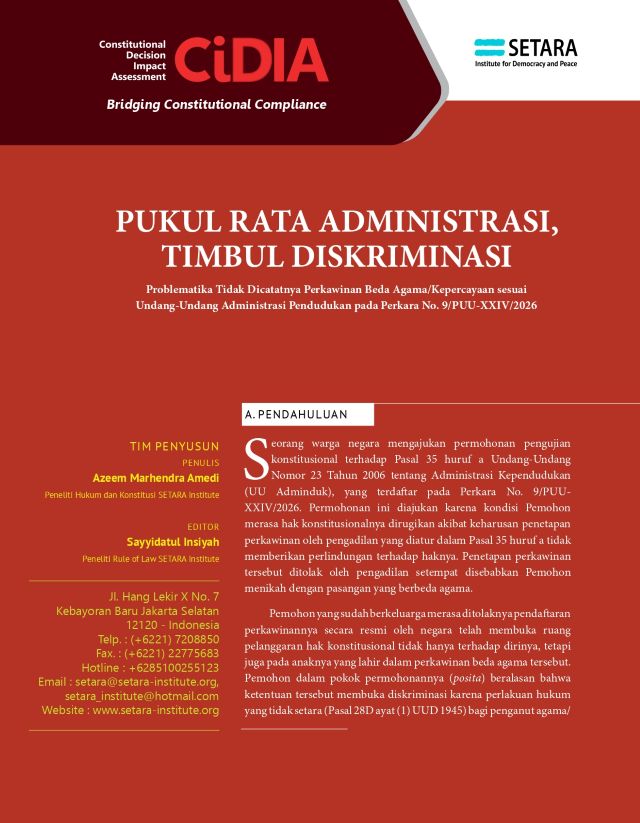
This document is a CiDIA policy study entitled “Flattened Administration, Emerging Discrimination: The Problem of Non-Registration of Interfaith/Interreligious Marriages under the Population Administration Law in Case No. 9/PUU-XXIV/2026.” The study examines the registration of interfaith/interreligious marriages from the perspective of constitutional rights and population administration, referring to the constitutional review petition concerning Article 35(a) of Law No. 23 of 2006 on Population Administration. The case was brought following the failure to obtain a court determination required for marriage registration, after a local court rejected the determination of a marriage between spouses of different religions. This situation raises concerns regarding the fulfillment of constitutional rights, not only for the spouses but also for children born from such marriages.
The study identifies three key issues: the obstruction of interfaith/interreligious marriage registration due to the absence of a court determination, the potential for discrimination and legal vulnerability faced by interfaith couples, and the implications of the Constitutional Court’s decision in Case No. 9/PUU-XXIV/2026 for the validity of judicial rules rejecting determinations of interfaith/interreligious marriages. Although the petition was declared inadmissible (niet ontvankelijke verklaard), the study emphasizes that interfaith/interreligious marriage remains an unresolved issue requiring serious attention from policymakers and judicial authorities, including the Supreme Court and subordinate courts, to ensure that population administration does not result in discriminatory treatment of citizens.