
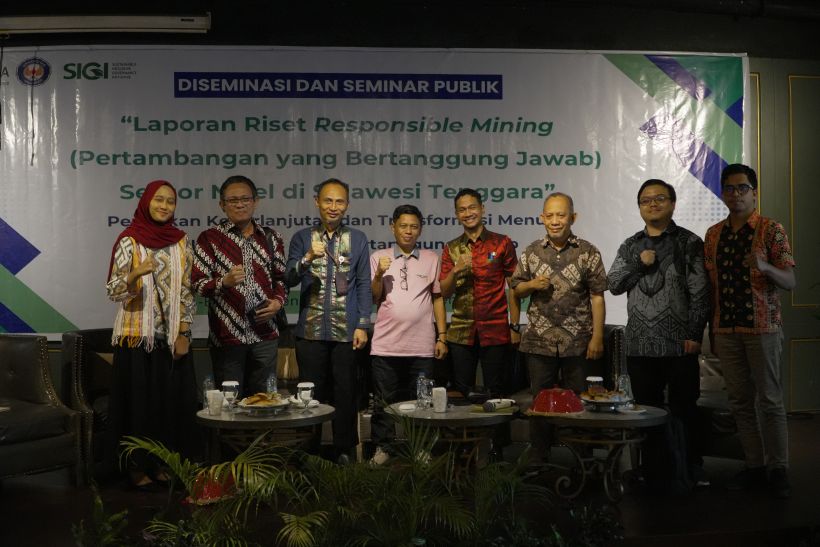
Outreach and Public Seminar on Responsible Mining in the Nickel Sector in Southeast Sulawesi, organized by Halu Oleo University (UHO) in collaboration with the SETARA Institute and Sustainable & Inclusive Governance Initiative (SIGI Initiative) on December 11, 2025, presented the complete findings of a study on nickel mining practices in two main locations: Konawe Regency and North Konawe Regency. This study was conducted to assess the current status of the implementation of responsible mining principles based on five variables of the Responsible Mining Assessment which refer to the Responsible Mining Index (RMI) 2022, the UN Guiding Principles on Business and Human Rights (UNGPs), IRMA (The Initiative for Responsible Mining Assurance), and national frameworks, including Presidential Regulation No. 60 of 2023 on the National Strategy for Business and Human Rights.
Given that Indonesia accounts for an estimated 62% of global nickel supply and that Southeast Sulawesi is one of the nation’s production hubs—with nickel resources totaling 61.3 million metric tons and nickel reserves of 20.45 million metric tons, according to 2024 data from the Ministry of Maritime Affairs and Fisheries— this study confirms that this significant economic potential is accompanied by substantial risks of loss, particularly regarding environmental impacts, worker safety, and low corporate accountability. The research found that there are 176 active mining permits (IUPs) in Southeast Sulawesi, while the processes of permitting, oversight, and community engagement still face substantial challenges.
This study employed a mixed-methods approach that combined a literature review, field assessments, multi-stakeholder focus group discussions, and in-depth interviews with community members and local government officials. The study area covers the operational areas of five mining companies in the Mandiodo Block, Molawe Subdistrict, North Konawe (PT Cinta Jaya, PT Sumber Bumi Putra, PT Bumi Nikel Nusantara, PT Bumi Konawe Minerina, and PT ANTAM) as well as two smelters in Morosi Subdistrict, Konawe (PT VDNI and PT OSS).
The first finding relates to the aspect of policy coherence, both horizontal and vertical. At the level of horizontal coherence, a number of national provisions are considered increasingly regressive, including the centralization of licensing and the reduction of the role of local oversight. Article 162 of the Mineral and Coal Law has the potential to be used as a SLAPP provision because it can be misused to criminalize activities deemed to hinder business operations. This situation contradicts the guarantee of public participation enshrined in Law No. 32 of 2009 on Environmental Protection and Management (PPLH). The centralization of permitting through the OSS (Online Single Submission) system, as mandated by the Job Creation Law, reduces multi-tiered oversight at the provincial and regency levels, thereby depriving the public of opportunities to provide input or monitor corporate activities. In terms of vertical coherence, a number of provincial and regency local regulations still maintain progressive standards regarding environmental audits, workplace safety, waste management, and community empowerment. However, policy changes at the central government level have the potential to weaken the effectiveness of these local regulations.
For the Responsible Mining Assessment variable, the findings reveal a significant gap between standards and practices.
In the area of Business Conduct, nearly all of the companies studied lack clear policies on anti-corruption, ESG, human rights, or supply chain governance. Initial outreach to local communities is generally not conducted, and overlapping mining permits (IUPs) have become a structural issue that triggers land conflicts. Local governments have stated that the OSS system eliminates opportunities for coordination, leaving them unsure of who holds IUPs and how companies operate. Most CSR/PPM programs are largely ceremonial and not based on community needs.
Regarding the variable Community Well-being, the study documented drastic changes in the socioeconomic functions of communities surrounding the mine. Fishing communities faced coastal sedimentation and pollution, forcing them to fish farther out to sea and requiring two to three days at sea. On land, the conversion of rice fields has reduced the area of productive rice fields from 5,000 hectares to 1,500 hectares, causing farmers to lose their livelihoods. An increase in cases of upper respiratory tract infections (URTI), skin irritation, and exposure to red dust has occurred, particularly in areas around schools near mining permits (IUPs). UHO academics have noted the loss of local traditions such as metanduale due to changes in social structure triggered by mining activities.
Regarding Working Conditions, the study found instances of child labor, weak enforcement of occupational safety and health (OSH) regulations, and unreported fatal workplace accidents. The disparity between local and non-local workers is very evident, with local workers generally filling only unskilled labor positions. Contract systems and outsourcing dominate labor relations, while training and development for local human resources are minimal.
The variable Environmental Responsibility indicates systemic violations. Nearly all sites reported water and marine pollution, extreme mining dust, uncontrolled sedimentation, and an increase in public health cases. Waste management systems, such as sediment ponds, were found to be non-functional, while post-mining reclamation was not actually carried out despite being included in company documents. The loss of vegetation and an increase in microclimate temperature were reported by local government agencies and the community. The Konawe Environmental Agency (DLH) also found hazardous contaminants in water samples taken near the smelter.
Regarding the variable Mine Location Indicator, the study found that information transparency is virtually nonexistent. The community, village government, and district government agencies do not have access to basic information such as the boundaries of mining permits (IUPs), beneficial owners, annual work plans (RKABs), or the results of water and air monitoring. There are no formal complaint mechanisms, hotlines, or community liaison officers. Environmental monitoring is not conducted regularly, and when it is, the results are not communicated to the public.
Taken together, these findings indicate that the five variables of the Responsible Mining Assessment have not been met, whether in terms of governance, environmental protection, or respect for human rights. The findings also show that information regarding the smelters—namely, PT VDNI and PT OSS—is very difficult for the public to access.
Based on these conditions, the study offers a number of recommendations. For the central government, it is recommended to strengthen the coherence of national policies by revising provisions in the Mineral and Coal Law that are susceptible to abuse, synchronizing regulations across ministries, increasing transparency in the extractive industries through minimum information disclosure, and implementing human rights due diligence as mandated by Presidential Regulation No. 60/2023 on the National Strategy for Business and Human Rights—which will be replaced by the Presidential Regulation on Human Rights Compliance Assessment for Business Entities as the mandatory basis for human rights due diligence. The central government is also recommended to establish a task force to monitor and review environmental and social aspects in the areas covered by the Morosi and Mandiodo mining permits (IUP) and the Molawe smelter.
For local governments, the study recommends restoring the role of integrated oversight among provinces, regencies, and the community; a review of the Regional Spatial Plan (RTRW) and the acceleration of regulations related to Sustainable Food Agricultural Land (LP2B); a review of permits held by IUP holders based on aspects of responsible mining as well as the strengthening of public complaint mechanisms through the establishment of local complaint offices and village liaison officers. Local governments are also expected to actively develop periodic baseline assessments of health and the environment and to follow up on reports of workplace accidents and labor issues.
Furthermore, recommendations were made to civil society organizations to expand independent monitoring, advocacy, and case documentation, as well as community-based economic empowerment; and to universities to conduct further research on socio-environmental impacts and the development of scientific guidelines for sediment control and coastal rehabilitation, as well as the formulation of participatory community development and empowerment (PPM) programs.
Based on these findings, the dissemination event underscored the need for systemic reforms in the governance of nickel mining in Southeast Sulawesi—specifically at two sites, Morosi (smelter) and Mandiodo (mine)—to bring them into alignment with the framework for responsible mining and to ensure environmental protection, community well-being, and respect for human rights.[]
Contact:
Prof. Ir. Yani Taufik, M.Si., Ph.D., Professor at the Faculty of Agriculture, UHO / Chair of the Research Team
Halili Hasan, Executive Director of the SETARA Institute
Nabhan Aiqani, Business and Human Rights Researcher at the SETARA Institute-SIGI Initiative