

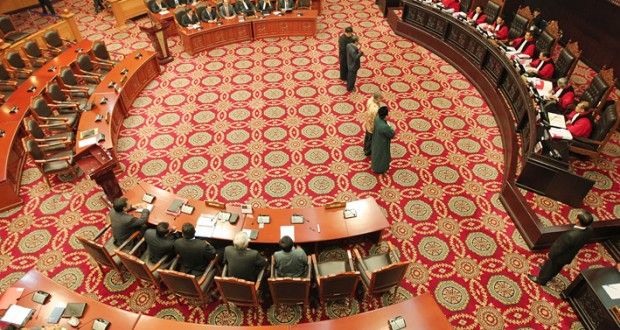
Bonar Tigor Naipospos, Vice Chair of the Setara Institute, said that the Constitutional Court (MK) is not fit to oversee itself. The MK’s stance—which has long been defensive toward external oversight—is counterproductive, especially given the public’s concerns about this institution tasked with safeguarding the constitution.
“The MK cannot oversee itself. Its decisions could be flawed because they are influenced by external factors. That is why it is important to have an institution to oversee constitutional judges,” said Tigor in Jakarta on Monday (11/11).
Based on the results of a survey of 200 constitutional law experts and human rights activists, the Setara Institute revealed that Government Regulation in Lieu of Law (Perppu) No. 1/2013 on the Second Amendment to Law No. 24/2003 on the Constitutional Court is irrelevant. This is particularly true regarding the existence of oversight bodies formed by the Constitutional Court and the Judicial Commission (KY).
The House of Representatives (DPR) is expected to carefully and thoroughly review the existence of Perppu No. 1/2013 in the interest of strengthening the Constitutional Court. The 200 constitutional law experts believe that oversight of the Constitutional Court should be carried out through revisions to the Constitutional Court Law and the Judicial Commission Law, with the aim of returning oversight authority to the Judicial Commission.
Tigor continued, explaining that the oversight conducted by the KY focuses more on the ethics and conduct of constitutional judges. It is not intended to alter the Constitutional Court’s rulings, which are final and binding.
“So it does not oversee the decisions themselves or the impact of those rulings. What is being monitored is the ethics and conduct of the judges,” he said.
The Setara Institute released the results of a survey titled “Perceptions of 200 Constitutional Law Experts on the Constitutional Court’s Performance.” The survey findings indicate that 200 constitutional law experts and human rights activists believe the arrest of former Constitutional Court Chief Justice Akil Mochtar by the Corruption Eradication Commission (KPK) in early October 2013 did not necessarily undermine the Constitutional Court’s authority. This is because 82.1 percent of respondents are confident that the Constitutional Court can restore public trust.
Setara Institute Chair Hendardi explained that during the 10 years since the Constitutional Court’s establishment, there have been no satisfactory ratings regarding the Court’s rulings under Akil Mochtar’s tenure as Chief Justice.
“There were no satisfactory ratings regarding the quality of rulings during Akil Mochtar’s tenure,” said Hendardi.
It was noted that under the three different leaderships, the performance and quality of the Constitutional Court’s rulings varied. Under Jimly Asshiddiqie’s leadership, 94.9 percent of respondents believed the quality of the Constitutional Court’s rulings was more academic, while 89.7 percent of respondents assessed the rulings as highly argumentative.
Meanwhile, during Mahfud MD’s tenure, 89.7 percent of respondents noted that the Constitutional Court’s rulings were more progressive, and 79.5 percent described them as well-reasoned.
“Under Akil’s leadership, however, the quality of rulings was perceived as more political, at 80 percent,” he said.
The survey, conducted by the Setara Institute, aimed to gauge the perceptions of 200 constitutional law experts and human rights activists regarding the Constitutional Court’s performance over the past 10 years. The Perception Index report, based on the views of 200 constitutional law experts, was compiled from October 7–15, 2013. This quantitative survey employed a purposive sampling method.
The Setara Institute selected and profiled 200 experts using a web-based survey, in which respondents filled out a questionnaire by logging into Setara’s dedicated website, “http://survey.setara-institute.org.” Selected respondents were provided with a “username” and “password” that could only be used once.
One of the recommendations put forward by the Setara Institute for the Constitutional Court to implement in the future is a systematic and sustained effort to restore public trust. One way to do this is by publicly disclosing the asset declarations and sources of wealth of the constitutional justices.