

Jakarta – Indonesia has once again made the list of countries with a poor record of human rights violations worldwide. This is detailed in a United Nations (UN) report compiled by Special Rapporteur Maina Kiai.
“(This is) a report on the state of freedom of assembly and association for minority and vulnerable groups,” said Haris Azhar, Coordinator of the Commission for the Missing and Victims of Violence (KontraS), during a press conference at the KontraS office, Jl. Borobudur No. 14, Menteng, Central Jakarta, on Thursday (May 15, 2014).
According to Haris, the report—which will be presented to the Human Rights Council this coming July—holds both moral and political weight.
“Countries around the world that wish to cooperate with Indonesia will review Indonesia’s track record across various aspects, one of which is its human rights situation,” added Haris.
This report is contained in UN public document No. A/HRC/26/29 dated April 14, 2014. Cases in Indonesia are summarized on page 13, point 4, paragraph 41.
It reads: “In Indonesia, for example, religious minority groups such as the Ahmadiyya, the Baha’is, Christians, and Shiites face physical attacks from Islamic militant groups, with minimal government intervention. Although the Supreme Court has issued a ruling upholding the right of the GKI Taman Yasmin congregation to construct their church building in Bogor, West Java, local authorities sealed the building in 2010 and have since prevented the congregation from entering their church.”
Reports of this nature also surfaced in 2012 and 2013. “So, after 2012 and 2013—when Indonesia was called out by many countries—here we are in 2014, and it’s happening again. This means the situation hasn’t improved year after year,” added Haris.
Given these records, Haris concluded that the SBY administration has failed to protect minority groups.
“This record confirms that SBY’s administration is incapable and has failed to protect minority groups,” he said.
This report will be submitted to the Ministry of Home Affairs. The hope is that President SBY, in the final months of his administration, will take concrete action to protect the religious beliefs of minority groups.
“For example, a Presidential Decree on the Protection of Minority Groups, so that this sends a signal and places an obligation on the next president, whoever he or she may be, that these groups are important and must be given protection. In fact, during the 10 years of SBY’s administration, the human rights situation in Indonesia has been quite alarming,” explained Haris.
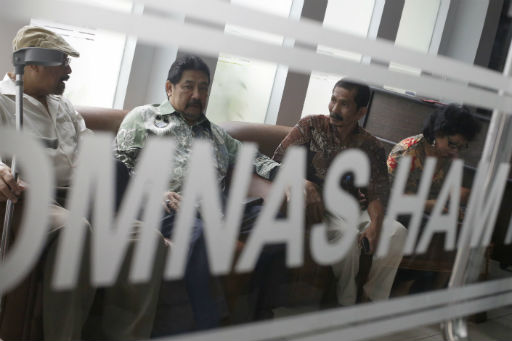
At this press conference, several representatives from minority groups were also present. They were Bona Sigalingging from GKI Yasmin, Deden Sujana from Ahmadiyah, and Maysha from OASE, a Shia community.
“Nip this problem in the bud. Hopefully President SBY still has the courage to resolve it now; otherwise, it will be passed on to the next president,” Bona said.