

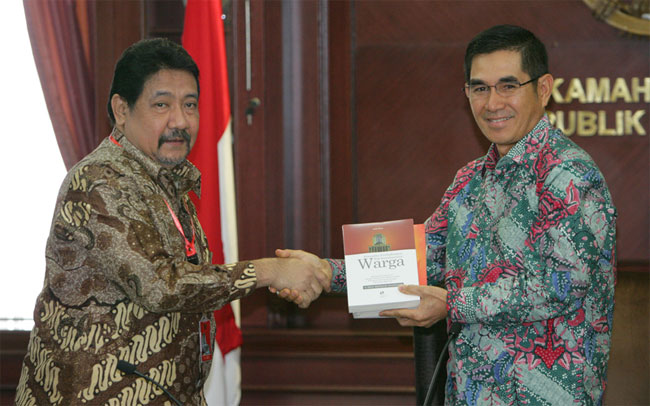
A delegation from the Setara Institute, led by Hendardi, visited the Constitutional Court (MK) on Friday (Jan. 10) morning. They were received by Constitutional Court Chief Justice Hamdan Zoelva, who was accompanied by Constitutional Court Secretary-General Janedjri M. Gaffar.
“The purpose of our visit to the Constitutional Court was to foster closer ties. Since the leadership of Mr. Jimly, and later Mr. Mahfud MD, we have always maintained communication and interaction with the Constitutional Court,” said Hendardi.
According to Hendardi, this courtesy visit is a way to continue building synergy between civil society and the state, to mutually strengthen one another. “This meeting is also our way of showing our appreciation for the Constitutional Court as an institution born out of the reform movement,” said Hendardi.
Hendardi added that since June 2013, the Setara Institute has been organizing a series of activities to commemorate the Constitutional Court’s 10th anniversary, including surveys, research on court rulings, national conferences, and the compilation of an “anatomy of rulings”—all as forms of civil society’s contribution and participation in promoting justice and strengthening the Constitutional Court.
Meanwhile, Constitutional Court Chief Justice Hamdan Zoelva highly appreciated the steps taken by the Setara Institute, including surveys, research on rulings, national conferences, and the analysis of ruling structures. Although since early 2008 the Constitutional Court has been busy handling disputes over regional election results, the Court’s availability to conduct studies and research related to the Constitution has become increasingly limited.
At the meeting, Hamdan shared his experiences visiting the German and Austrian constitutional courts. In Germany, 5,000–6,000 cases are filed with the constitutional court each year, and the same is true in Austria.
“So I asked the German constitutional judge, ‘Why are there so many cases?’ They replied that if not all cases reached the Constitutional Court, the public would feel unsatisfied. So, they always end up at the Constitutional Court,” Hamdan explained.
Hamdan further addressed the case involving Akil Mochtar, which dealt a severe blow to the Constitutional Court. “We were deeply shaken and hope that such a case will not happen again,” Hamdan added. “Our hope is that the case involving Mr. Akil will be resolved quickly,” Hamdan told the Setara Institute delegation.
Regarding efforts to safeguard the Constitutional Court’s independence, Hamdan explained that a Constitutional Court Ethics Council has now been established to uphold and enforce the honor, dignity, code of ethics, and conduct of constitutional judges. (Nano Tresna Arfana/mh)