

The Disbandment of the Tan Malaka Discussion and the Raid on a Gathering of Former Political Prisoners
“The Symbiosis Between Civil Society Organizations and the Police Is Always Maintained”
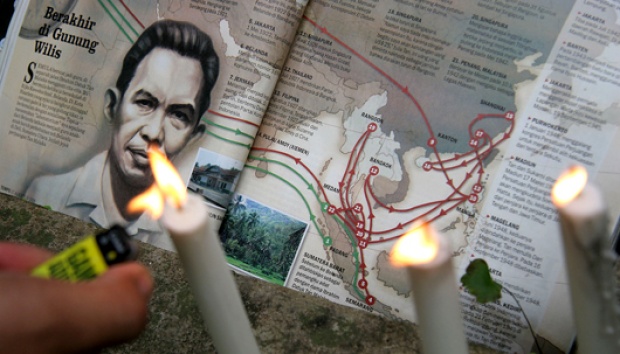
Within a short span of time, two civil society events were disbanded. The forced dissolution of these events was allegedly due to their suspected ties to the Indonesian Communist Party (PKI). The first event to be dissolved was a book discussion of Harry A. Poeze’s work titled “Tan Malaka, the Leftist Movement, and the Indonesian Revolution, Volume 4,” held at Gerobak Art Hysteria, 29 Stonen Street, Semarang. Second, a gathering at a resident’s home on Jalan Potrosari Tengah RT 04 RW 01, Srondol Kulon, Banyumanik, was dispersed, and participants were arrested. The dispersal and arrests were carried out at the insistence of the mass organizations FPI and PP, which had previously threatened to launch an attack if law enforcement did not act immediately.
Police officers and TNI Koramil units—who are supposed to protect and serve the public—actually acted in a contradictory manner. State security and defense forces instead became part of the group opposing these two civil society activities, even going so far as to arrest 10 elderly individuals. A cynical and paradoxical attitude toward the resurgence of communist ideology was the primary reason for the dispersal of these events.
The SETARA Institute condemns the dispersal and arrests that took place during these two events. This is because such actions violate citizens’ constitutional rights to access information and education, including through academic activities such as book discussions. Furthermore, they constitute violations and infringements of the constitutionally guaranteed rights to assembly and association.
SETARA Institute believes that excessive fear and hatred of communism will undermine the national reconciliation efforts initiated by various parties.
The SETARA Institute calls on security forces—in this case, the police—to once again refrain from bowing to the pressure of certain mass organizations and to provide protection and security to citizens so they can exercise their rights to assemble and express themselves, as protected by the 1945 Constitution of the Republic of Indonesia.
Contact Persons:
BONAR TIGOR NAIPOSPOS, Vice Chair of the SETARA Institute, 0811.819.174
INDRA LISTIANTARA PUTRA, Researcher at the SETARA Institute, 0813.856.325.82