

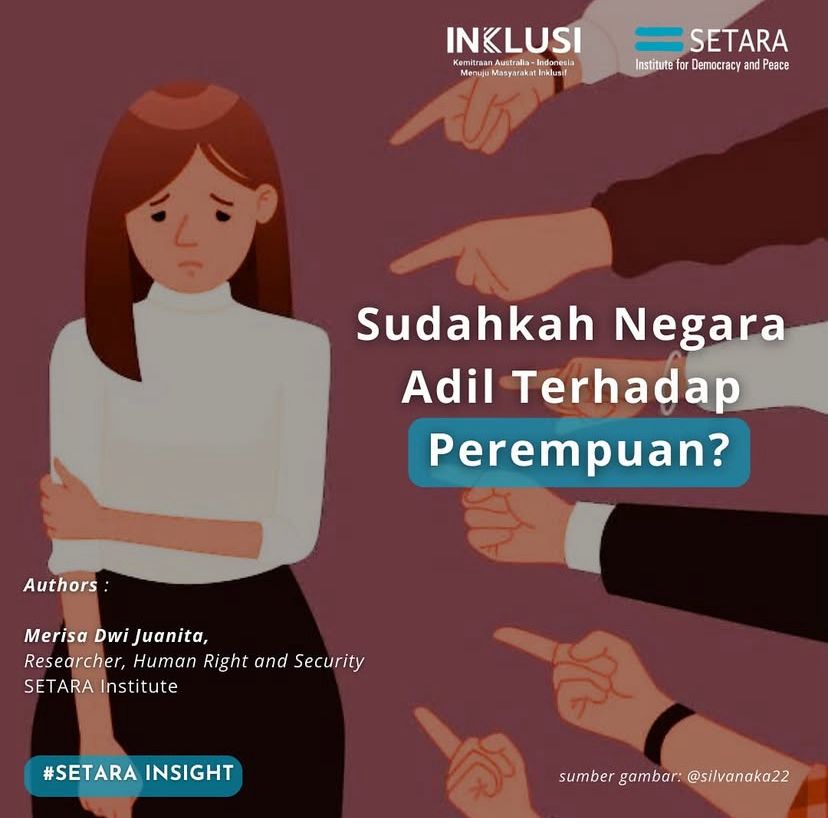
Deeply rooted patriarchal norms continue to pose a major obstacle to accelerating gender equality. In this context, women are often confined to or expected to remain within the domestic sphere rather than participating fully in public life. Women continue to be disproportionately affected as a vulnerable group through various forms of injustice arising from social structures, patriarchal workplace environments in the private sector, and limited opportunities for participation created by state policies.
Violence against women, coupled with their limited participation in public life, constitutes a serious human rights violation that reflects the persistence of patriarchal culture in Indonesia. Such practices not only contradict the humanitarian values enshrined in the second principle of Pancasila, but also violate numerous legal instruments and policy frameworks, including the Convention on the Elimination of All Forms of Discrimination against Women (CEDAW), Presidential Decree No. 36 of 1990, the Beijing Platform for Action (BPFA), Presidential Instruction No. 9 of 2000, Presidential Regulation No. 111 of 2022, Law No. 23 of 2014, the Law on the Elimination of Domestic Violence (2004), Law No. 7 of 1984, as well as provisions of the Indonesian Criminal Code (KUHP) that classify sexual violence as a criminal offense against morality.
According to the 2021 Annual Report (CATAHU) of the National Commission on Violence Against Women (Komnas Perempuan), 335,399 cases of Gender-Based Violence (GBV) were recorded in the personal sphere, making it the most frequently reported form of violence. Over the past two decades (2001–2021), more than 2.5 million cases of Gender-Based Violence in the personal sphere have been documented. These include 484,993 cases of violence against wives and 26,629 cases of dating violence. More than 87,000 cases of Gender-Based Violence were reported in the public sphere, with sexual violence accounting for the largest proportion (34,453 cases). Violence perpetrated by state institutions was also documented in 2,292 cases, with forced evictions and natural resource conflicts among the most frequently reported incidents.
Another deeply concerning trend is that perpetrators of violence are not limited to anonymous individuals. They also include people in professions that are expected to uphold public trust and serve as role models, such as religious leaders, public officials, university lecturers, teachers, members of the Indonesian National Armed Forces (TNI) and the Indonesian National Police (Polri), and healthcare workers. Violence occurs across various settings—including workplaces, educational institutions, hospitals, and digital spaces—which should instead serve as safe environments for women.
Several other critical issues also require urgent attention, including femicide, Online Gender-Based Violence (OGBV), violence in educational and religious institutions, violence against women with disabilities and members of sexual minority groups, discrimination in political participation, and gender-based torture in detention facilities.
These figures represent far more than statistics; each case reflects a woman whose rights have been violated and whose life has been placed at risk. Without serious structural reforms—including stronger public policies, more effective legal protection, and transformative changes in social norms—women will continue to face disproportionate vulnerability to violence and discrimination, perpetuating cycles of abuse across future generations.
Greater state intervention is therefore essential to build a more inclusive system that ensures women, particularly those from vulnerable groups, receive adequate protection, meaningful participation, and equal access to justice, education, and economic opportunities. Such efforts are fundamental to achieving human development in accordance with the principle of “no one left behind.”
Reference:
Komnas Perempuan (2023), A 21-Year Review of Komnas Perempuan’s Annual Reports (CATAHU).
Author:
Merisa Dwi Juanita
Researcher, SETARA Institute