

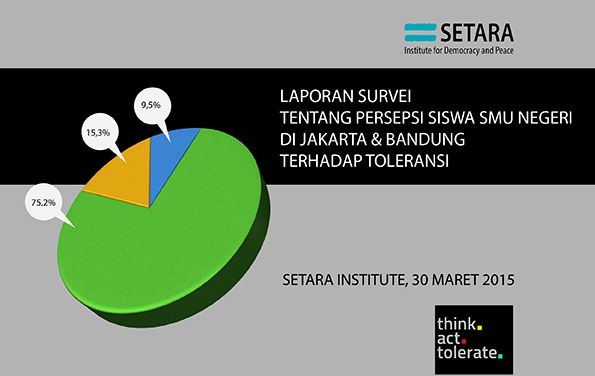
To assess the state of tolerance in the education sector, the SETARA Institute conducted a survey of high school students in Jakarta and Bandung. This survey aims to provide a clear and valid baseline for developing educational interventions on tolerance in schools. Jakarta and Bandung were selected as the study areas because Jakarta serves as a barometer for cities in Indonesia, and Bandung is a region with high levels of intolerance, as indicated in annual reports monitoring the state of freedom of religion and belief.
This perception survey had a population of 171 public high schools and a sample of 114 schools. Of these, 76 were in Jakarta and 38 in Bandung, using the simple random sampling method. From each school, 6 students were selected as respondents, bringing the total number of respondents in this survey to 684. With a population of 171 schools, this survey has a 95% confidence level with a margin of error of 4.7. The survey was conducted from March 9–19, 2015, involving 114 interviewers. Spot checks were conducted on 20% of the sample as a quality control method. This survey does not represent the trends among high school students throughout Indonesia.
In addition to examining the demographic characteristics of the respondents, this survey measured three variables: (a) general knowledge about tolerance, (b) the sociopolitical dimension, and (c) the ideological dimension.
The breakdown of respondents in this survey was 56.3% (385 respondents) male and 43.7% (299 respondents) female. The majority of respondents were Muslim (86.3%). The respondents were distributed across three locations: 52.5% in Jakarta, 5.1% in Banten, and 42.3% in the Greater Bandung area.
The majority of respondents in this survey—67%—cited the internet as their primary source of information. Meanwhile, 29.1% chose television. The remainder cited newspapers, educational programs, and other sources. The majority—52.0%—stated that they frequently access the internet and other media throughout the week, while 38.5% stated that they do so occasionally.
The students who participated in this survey took part in both intracurricular and extracurricular activities. Their favorite activities were sports (33.9%) and spiritual activities (10.1%), followed by martial arts, Scouting, the Red Cross Youth (PMR), the school band, and others. In addition to school activities, the students in this survey also participated in religious activities outside of school. A total of 35.4% of respondents participated in religious activities outside of school, while the majority—57.6%—stated the opposite. Furthermore, this survey also identified the specific activities students engaged in outside of school. A total of 27.3% participated in Rohis/Rohkris activities, 22.3% in mosque youth groups, 9.1% in church youth groups, and 20.7% in religious study groups. The remainder included religious celebrations and religious studies. The survey also found that 48% of students acquired religious knowledge from their religious education teachers at school. Meanwhile, 18% learned from their parents, and 12% from the media.
A. Dimensions of Student Knowledge
A total of 64.8% of respondents stated that students perceive their religious education teachers as having provided sufficient knowledge about tolerance. Meanwhile, 20.9% stated that religious education teachers do not or have not yet provided knowledge about tolerance. Among the respondents who stated that religious education teachers have provided knowledge about tolerance, 54.4% stated that these teachers have clearly explained the meaning of diversity. Meanwhile, 28.7% stated the opposite: that religious education teachers in schools have not yet provided clear knowledge on the subject.
Regarding the curriculum or religious education content, students believe that religious education supports an understanding of diversity (49.9%). Meanwhile, 31.8% stated the opposite. The rest said they did not know.
Students’ understanding of tolerance can be considered progressive. As many as 75% of students believe that tolerance means respecting differences and preventing conflict. This means that they do not merely accept diversity as a socio-anthropological fact; rather, they view tolerance as something worth fighting for (civic pluralism). With this progressive view, the majority of students reject policies of homogenization in the name of a particular religion (76.5%)—where everyone is required to follow the most widely practiced religion. They state (90.8%) that everyone is free to embrace a religion and beliefs according to their conscience, because in the eyes of the respondents (74.4%), Indonesia is a country that values diversity.
B. Sociopolitical Dimensions
In line with students’ understanding of tolerance, 79.5% of students do not consider religious factors when choosing friends. However, when their acceptance is tested, there are varying degrees of acceptance or willingness across each aspect used in the assessment. A total of 86.5% accept those from different social groups. They accept those of different religions (90.4%), those of different ethnicities (92.4%), and those of different skin colors (95.2%).
Still on the topic of social issues, 95.2% of respondents said they would visit a friend who had suffered a misfortune. However, when it came to requiring high school girls to wear the hijab, respondents’ opinions were divided. Forty-four percent said they disagreed, while 38% said they agreed with the hijab requirement.
Almost every school has a place of worship. This view was affirmed by 92.1% of students. Another positive finding in this regard is that 74.4% of students agree that schools should provide places of worship for all religions. A positive figure was also recorded regarding the holding of religious activities at school for all religions practiced by students (70.6%). Meanwhile, regarding access to school facilities for all religions, 68.7% expressed their agreement.
In this survey, 72.2% of respondents said that leaders at the RT, RW, village head, and regent/mayor levels do not have to share the same religion. Meanwhile, 22.2% said they must share the same religion. However, if a head-to-head election pits candidates of different religions against each other, the candidate of the same religion would be chosen (34.5%). The majority would still not make religious background an issue (57.7%).
C. Ideological Dimension
On the ideological front, several issues were used as test cases. The first section concerned the Shia and Ahmadiyya branches of Islam. A total of 35.4% of students had heard of the Ahmadiyya and Shia. The remaining 57.6% stated they had never heard of them. Of the 35.4% (242 respondents), 43.8% stated that they agreed with restrictions on the Shia and Ahmadiyya, while 27.7% stated they disagreed.
Respondents were also asked about the idea of replacing Pancasila with a religious foundation. A total of 8.5% of respondents (58 students) said they agreed that Pancasila should be replaced with a religious foundation. Meanwhile, the majority—69.3%—said the opposite: they disagreed.
Students also support certain organizations that prohibit the establishment of places of worship (11.3%); use violence to defend their beliefs (7.3%); seek to replace Pancasila as the state ideology (8.1%); and spread hatred toward other religious groups or denominations (4.2%). Although support for the above aspects is relatively low, these percentages must be taken seriously by all parties.
Of all the students who participated in this survey, the majority (75.3%) had heard of or were aware of the Islamic State in Iraq and Syria (ISIS). Among these 75.3% (516 respondents), each respondent had different impressions. A total of 36.2% believed that ISIS is a brutal terrorist group. Consistent with their first impression, 30.6% of respondents viewed ISIS as perpetrators of violence carried out in the name of religion. Only 16.9% stated that ISIS is fighting to establish a global Islamic state (a global Islamic caliphate). The remainder stated that ISIS is anti-Western (4.5%).
Of the 516 respondents (75.3%) who stated they were aware of ISIS, 9.5%—or 49 respondents—agreed with the movement. Considering the total number of respondents was 684, this figure of 49 represents 7.2%. In other words, at least 1 out of every 14 students agrees with the ISIS movement. This agreement does not imply that students are interested in getting involved in the ISIS movement. However, this approval rate also serves as a serious warning for Indonesia.
Read more:
View Publication
student-survey-presentation-graphs.pdf