

Press Release from the SETARA Institute and the Constitutional Democracy Forum (CDF)
February 19, 2014
Politicians’ Eager Pursuit of Constitutional Court Justiceships:
THE RESTORATION OF THE CONSTITUTIONAL COURT’S INTEGRITY IS FURTHER AWAY THAN EVER
The issuance of Government Regulation in Lieu of Law (Perppu) No. 1 of 2013 on the Constitutional Court was prompted by the government’s concerns and subjective response to the arrest of Constitutional Court Chief Justice Akil Muchtar on Wednesday, October 2, 2013. For the government, this situation would lead to chaos in development and the sustainability of the legal system in Indonesia. The government interpreted this as a state of emergency. The enactment of the Perppu was believed to be the right solution to accelerate the Constitutional Court’s recovery from its current predicament.
The legal-political framework, along with all the arguments presented by the government, gained legitimacy from the legislature. The House of Representatives’ endorsement of the Perppu was marked by the enactment of the Perppu on the Constitutional Court into Law No. 4 of 2014 concerning Perppu No. 1 of 2013 on the Second Amendment to Law No. 24 of 2003 on the Constitutional Court.
The DPR’s open acceptance of the Perppu signed by President Susilo Bambang Yudhoyono came as no surprise to the public. This was because the majority of parliament members were from the Democratic Party-led coalition. The Democratic Party succeeded in uniting the votes through the political solidarity of the coalition parties to support the existence and implementation of the “regulatory measure to save the Constitutional Court.”
Following the arrest of Akil Muchtar, the composition of the Constitutional Court—which should consist of 9 (nine) justices—has been reduced. The vacancy on the Constitutional Court is also due to Harjono reaching retirement age. As a result, there are 2 (two) vacant positions on the Constitutional Court.
Decision No. 1-2/PUU-XII of the Constitutional Court of the Republic of Indonesia on the Review of Law No. 4 of 2014 concerning Government Regulation in Lieu of Law (Perppu) No. 1 of 2013 on the Second Amendment to Law No. 24 of 2003 on the Constitutional Court, Converting It into a Statute —not only reaffirms that the Judicial Commission lacks the authority to oversee Constitutional Court justices but also restores the authority of each state institution (the President, the Supreme Court, and the House of Representatives) to select candidates for Constitutional Court justices without going through an expert panel and allows politicians to participate in the selection process for constitutional court justices without having to wait seven years after leaving their political party.
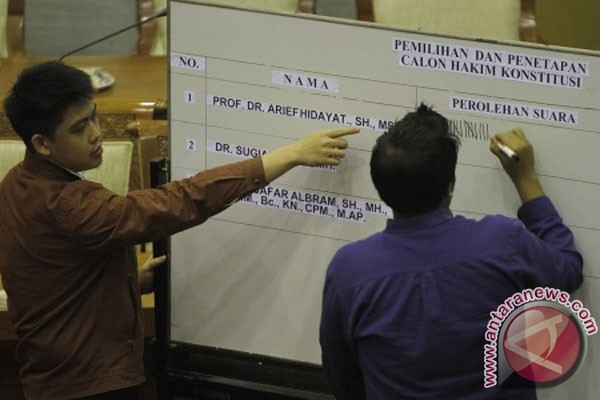
The vacancies for two Constitutional Court justices and Constitutional Court Decision No. 1-2/PUU-XII were, in fact, welcomed positively by a number of politicians in Senayan. Politicians serving as members of the House of Representatives (DPR) rushed to participate in the selection process for parliamentary representatives to the Constitutional Court. Yet previously, they had agreed to the conversion of the Government Regulation in Lieu of Law (Perppu) into a law that restricted politicians’ involvement as Constitutional Court justices. This illustrates that political decision-making in the DPR is nothing more than horse-trading for short-term gains.
The SETARA Institute and the Constitutional Democracy Forum (CDF) believe that politicians’ enthusiasm for participating in the selection process for Constitutional Court justice candidates reflects an inconsistency that should not be held up as a model. This attitude underscores that members of the House of Representatives lack a solid foundation of legal knowledge regarding the politics of lawmaking, including moral and ethical adherence to their previous political stances. SETARA Institute and the Constitutional Democracy Forum (CDF) reject the participation of politicians—particularly those from coalition parties—in the selection of Constitutional Court judge candidates to replace two sitting justices.
SETARA Institute and the Constitutional Democracy Forum (CDF) urge that the vacancies for the two Constitutional Court justices be filled by academics and civil society leaders who possess legal expertise and are free from “political interests.” Furthermore, the SETARA Institute and the Constitutional Democracy Forum (CDF) encourage the House of Representatives to involve experts in the recruitment process to ensure the selection of high-quality justices. This innovative approach by the House of Representatives to involve experts can dispel—or at least reduce—public suspicion and doubt regarding the House’s selection of two new Constitutional Court justices from among its own members.
Contact Person:
Ismail Hasani, Research Director at the SETARA Institute, Lecturer in Constitutional Law at UIN Jakarta, and Presidium Member of the Constitutional Democracy Forum (CDF): 08111 88 47 87