

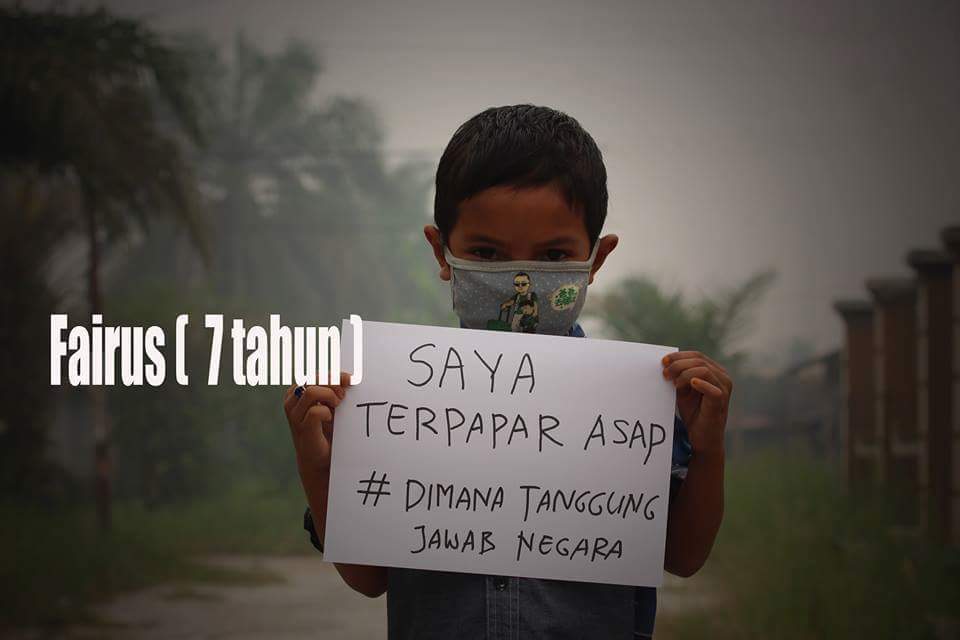
The report on Smog and the Urgency of Adopting the United Nations Guiding Principles (UNGP) is a thematic report by the SETARA Institute produced by the SETARA Institute Research Group in charge of Business and Human Rights (HAM) issues. The choice of the smog theme is intended to answer the actual need for comprehensive and sustainable steps on how the government and the business sector design accountable regulations and management in managing and developing businesses, especially in the plantation and forestry sectors.
Causes of the Smog
The smog that has hit most parts of Indonesia is not the first event to occur in forest and peatland areas. For approximately 18 years, smog events caused by forest and land fires have occurred. In 2015, this event attracted widespread attention because the escalation of fires and the volume of smoke exceeded normal limits. From various sources, several causes of the fires were identified: (a) extremely hot temperatures as an impact of global warming, (b) burning by responsible parties, (c) peatlands converted into plantation areas, (d) lack of significant prevention by authorities, (e) sluggish handling, especially fire extinguishing, and (f) weak law enforcement. Others mentioned that the fires are an impact of non-compliance by entrepreneurs and farmers in understanding regulations as well as low field supervision. Environmental activist groups assure that the cause of forest fires is the result of corporate actions that make burning a modus operandi as an effective way to clear new land, clean land, including arguments for insurance claims.
From a regulatory perspective, Law 32/2009 concerning Environmental Protection and Management also leaves problems. Article 69 paragraph 1 (h) of the a quo Law states that everyone is prohibited from clearing land by burning. But the contradiction appears in the same article in paragraph 2 which states that the prohibition on burning depends on local wisdom, which by the explanation of the a quo Law is stated that burning is allowed to clear a maximum of 2 hectares of land per Head of Family to be planted with local varieties and surrounded by firebreaks to prevent the fire from spreading to the surrounding area. There are at least 4 regulations that allow conditional burning in clearing land. From all those causes, what is certain is that the cause of the fire is not singular and therefore all parties must take a role and responsibility.
As of October 27, 2015, the Head of the Data and Information Center of the National Disaster Management Agency (BNPB) Sutopo Purwo Nugroho said the area of forest and land fires (karhutla) that occurred in 2015 reached 2,089,911 hectares. Of this amount, according to BNPB data, the 2015 karhutla was actually not dominated by peatlands. Burned non-peatlands up to October 20 had reached 1,471,337 hectares, with 3,226 hotspots as of October 21, 2015.
Regarding Impacts and Handling
Identifiable short-term material losses are more than Rp20 trillion. Meanwhile, the government has disbursed a budget of Rp500 billion. These funds are divided for aircraft and helicopter rental funds, the implementation of artificial rain, personnel deployment, to the activation of posts. Meanwhile, the death toll until October reached 19 people and 529,527 people suffered from ARI (Acute Respiratory Infections). Other unidentified losses, including social and immaterial losses, are certainly broader than what has been calculated.
Looking at the identified data, this report is primarily not intended to provide technical input on handling at this time, but is primarily aimed at how in the long run similar events do not recur. This report believes that international principles on accountable business ethical standards as outlined in the UN Global Compact and United Nations Guiding Principles for Business and Human Rights (Ruggie’s Principles), if adopted and truly enforced, can be a middle ground between the corporation’s need to expand land as a pillar of national industry and the fulfillment of ethical responsibilities and corporate legal responsibilities which in the Ruggie’s Principles scheme have an obligation to respect human rights (to respect) and the provision of recovery mechanisms (access to remedy).
The government through the National Disaster Management Agency (BNPB) has carefully and seriously handled forest and land fires. Besides providing an allocated budget of Rp. 500 billion, BNPB also still has on call funds of 2.5 trillion. The performance across ministries/agencies in general has shown the government’s seriousness in handling the smoke disaster. Besides the TNI/Polri, a number of companies have also shown their involvement in handling the smoke, especially in terms of extinguishing fires in their respective concession areas. However, according to some quarters, the government is considered late in handling this disaster, especially in terms of extinguishing fire sources (hot spots) so that the fire spreads wider.
Regarding environmental law enforcement, the government through the Ministry of Environment and Forestry has also played its role as an environmental law enforcer by issuing three types of sanctions, against at least 14 companies. However, for some quarters, this environmental law enforcement has not escaped criticism, especially because it is not carried out accountably. Even though a number of companies are identified as having conducted burning, the environmental law enforcement process must still prioritize a fair, open, and accountable process, so as not to be counterproductive to the Jokowi-JK Government’s efforts which prioritize economic development. The environmental law enforcement process is generally protested by a number of companies because of the absence of a fair objectification process.
Read more: Summary of Thematic Report on Smog and the Responsibility to Fulfill Human Rights